Showing posts with label River Ouse. Show all posts

Tuesday, 2 October 2018

Heartland Walks #3: Ghosts of the Harbour


Familiarity leads not to contempt, but to renewed astonishment.
With familiarity, from the known is yielded the unknown, the seen the unseen, the heard the unheard.
A flood of the senses by the rising ghost tide.


The artist Simon Lewty wrote that "the same walk can mean something different each time it is made, so that familiarity may not lead to contempt, but to renewed astonishment, as the known yields up the unknown"1. I felt renewed astonishment with my discovery of the relics of the old tidal harbour at Bishopstone, the scars of the old creek that run in a loop which joins the dots of five ponds in what is now a damp pasture. Countless times have I walked around this meadow and many times have I looked and wondered at its curious ditches and embankments, but always only in isolation and never before seeing it as a whole system, a system which carries downstream, away from the village and on towards The Buckle, beyond the causewayed coast road and Seaford branch line, beyond into the scars of the old Ouse, towards the sea.

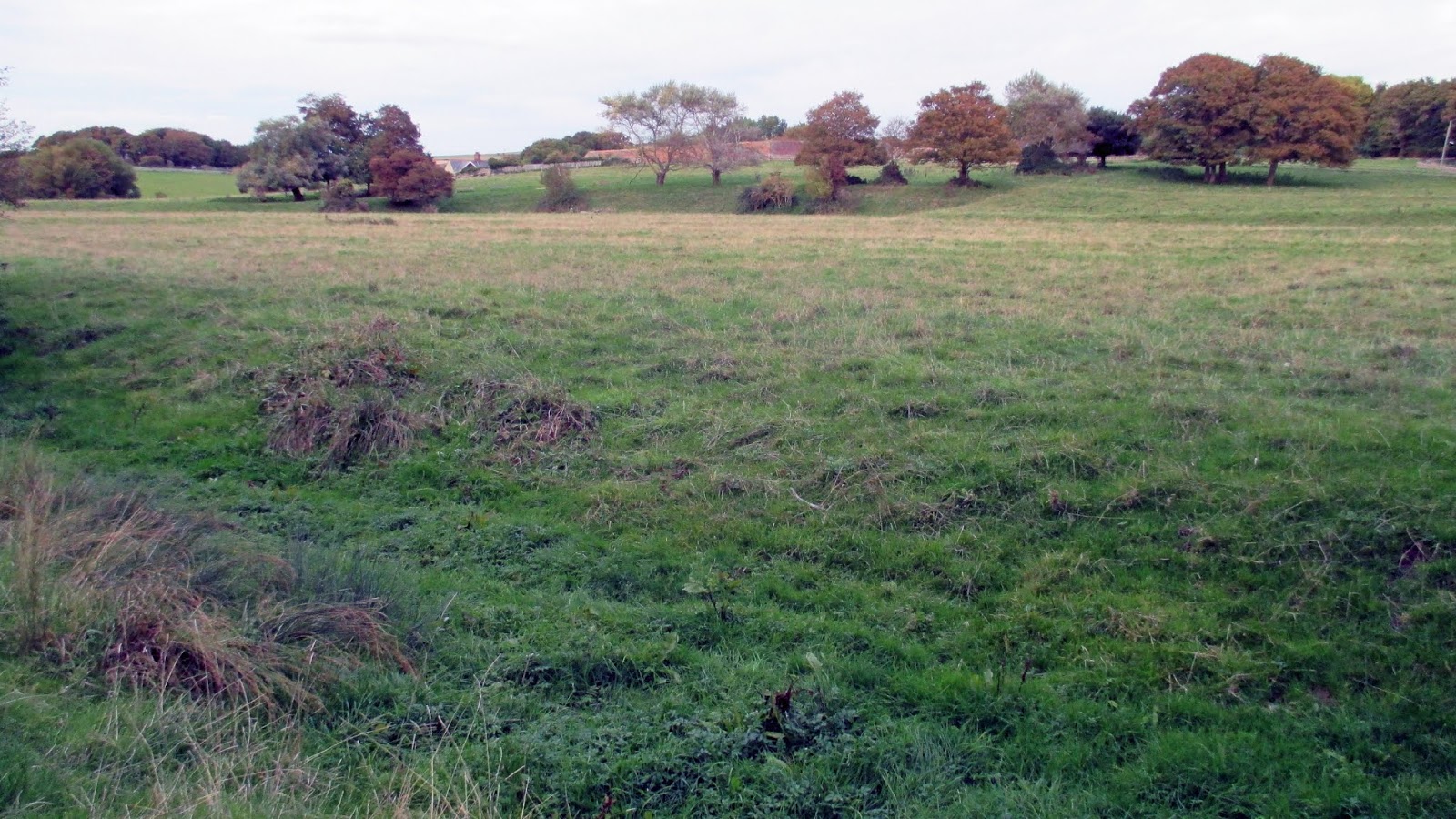
The shallow cleft has been present every one of the thousand and more times I walked through the meadow, hiding in plain sight, unnoticed. Two hundred and seventy years ago I would have been waist-deep in ooze. Today it is a mere suggestion, fragmented into a necklace of damp hollows and seasonal ponds, some not much more than big puddles distressed by cattle-hoof imprints which makes my own passage tiptoe teetering and treacherous. Events downstream repurposed this from a place of departure and return into a place where the twice-daily tidal heartbeat has slowed-slowed to a seasonal ebb and rise of wet and dry, winter and summer, watched over by the resident cattle and transient walkers and dog-walkers. The twice-daily tide has been reduced to a once-a-year event.

Today I choose to dwell a while, to trace the loop of the channel and chart a meandering course where boats once negotiated the shallows. Where once the flow would have scoured clean the channel, now there is a detritus of things stranded in space and time. The ruins of a concrete drain float on the surface, perhaps shattered by the seasonal heave of wet and dry ground. It could be a hundred year-old drainage improvement effort. There's a flotsam of wooden posts and planks that might have been fences or bridges that once spanned the channel. Glass bottles and flints from the decaying wall bob up and down in the shallows. After the hottest, driest summer in years, the ground here, where once redshanks called their melancholy ‘teu teu’, still remained damp enough to sustain a carpet of redshank - that dense matted flower of ditches and damp places. So the bird has become the flower.

I pause and listen to the birdsong: jackdaws and rooks and woodpigeons above, magpies, long-tailed tits, a chiff-chaff, greenfinches, a great spotted woodpecker. Creatures of the wood.  Where once rain would have fallen into the creek and flowed downstream, now a large beech – surely one of the Duke's beeches, planted after the water receded – rains its mast into the channel, slowly filling it. Two grey squirrels dart around its base where once grey mullet swam. A large owl nest box has been fixed to a sycamore trunk. I've never noticed it before, tucked away beneath the lowest boughs. Somewhere in the boughs above, the tawny owl calls as I discover this little secret of the wood’s edge. Perfect timing! To my right, low across the open meadow a sparrowhawk sweeps in attack. Then a grey heron glides in - that's more like it! And then a moment of eerie and wonderful splendour: the bubbling ripples of a curlew’s call, somewhere in the near distance, unseen but up there on shivering wings, the call ‘cour-lee’, truly a song of the heart.  The sound echoes through the trees with a moment's sustain, gaining in urgency: ‘troo-ee troo-ee trrroo-eee’. For a moment the air boils, then falls silent and they are gone. The ghosts of the old harbour are bubbling up through the ground like a wellspring and I have sunk knee-deep into its memory simply by pausing here for a few moments. This land is willing to yield its secrets to anyone who cares to ask.

The long wave of the last tide ebbed away from this place 250 or so years ago. The harbour may have gone extinct, but the wet never quite left - it has lingered as a half-memory, a half-remembered purpose it once held here, a shade or an imprint. The water haunts the meadow, benign in summer and autumn, resolute in winter and spring; the almost imperceptible year-long tidal ebb and rise. 
 
Global sea levels have risen by about 20cm since 18802. They are predicted to rise this century by about a further 65cm3, many studies suggest by as much as or even more than one metre, as oceans continue to thermally expand and as ice sheets melt. This rise might not revive the little harbour, but it would allow the water back in and restore it as a more dominant influence4. It might push people further from it and encourage the return of wading birds and wildfowl. The distant curlews' call may yet return here, but for now I have to walk on towards the Ouse floodplain to find them.

Sea level model following a sea-level rise of one metre


References
1.    Clifford, Sue and King, Angela (Eds.) (1996) From Place to Place: Maps and Parish Maps. London: Common Ground.
2.    US Global Change Research Program: Global Sea Level Rise https://www.globalchange.gov/browse/indicators/global-sea-level-rise (retrieved 02/10/18).
4.    http://www.floodmap.net/  (accessed 02/10/18).


The creek crosses the road at the dip
One of five ponds at Bishopstone
Damp hollow
Beech-mast raining into the old creek
Redshank (Persicaria maculosa)
The harbourside where boats moored?
Drainage hole in the wall...
...of the seasonal pool
The former harbourside?

Friday, 28 September 2018

Heartland Walks #2: Rookery Hill and Bishopstone


Ambiance: atmosphere, feel, setting, environment, mood, character, air, quality
Heartland: core, hub, nucleus, focus, centre, middle
Here: now, at this time/point/juncture
Locale: location, setting, place, milieu, area, locality, site, spot
Locality: area, neighbourhood, zone, vicinity, section, quarter, ghetto, district
Milieu: setting, environment, scene, background, situation, location, locale, ambiance
Neighbourhood: area, region, district, locality, zone, quarter, vicinity
Surroundings: environs, settings, environments, backgrounds, backdrops, atmospheres, ambiences
Vicinity: neighbourhood, district, locality, area, purlieu, locale


The rain is already close as Leo and I lock up and disappear into the weekend. The forecast predicts rain is still two hours off, but the dark phalanx of cloud marching eastwards suggests otherwise. The first spots are felt before we’ve walked a quarter of a mile and my wet weather gear is out and on as the curtain of rain washes over us. The ferry disappeared into it moments before and is gone, like disappearing into a waterfall. The wind is fidgety: a low breeze carrying the whiff of Newhaven’s industrial Saturday morning rises to a headwind, surfing the first enthusiastic rain wave, then settles back to near calm with the steady rain. We are crossing the chalk east ridge of the Ouse valley in search of the floodplain below. I have felt a growing appetite to watch and hear Curlew as they return from their upland nesting sites to coastal wintering grounds. We will explore the heartland of the Ouse floodplain. The tide is high and rising, so there is a good chance they will be sitting it out somewhere in or around the Ouse Estuary Local Nature Reserve. From a trig above The Rookery, the narrow ribbon of the Mill Drove shines wet and bisects the Tide Mills ruins. To its east the land stretches flat to the Buckle and curves inland through the old Pelham estate towards Bishopstone and its church sat slightly elevated above the once-marsh, where now a criss-cross of drains cut through damp meadows which still become a shallow wetland in winter. Curlews and countless other waders once would have piped the mudflats at low tide. Surrounding escarpment and steep ridges show where the tides would once have lapped up to twice-daily. This, then, shall be our starting point.

The road to the village at Bishopstone rises gently, so once over the stile built into the flint wall, one drops down into the floodplain below. A path into Bishopstone Wood - the Rookery - is a causeway between two ponds which dry out during good summers. Three other ponds lie nearby. They're alive with dragonflies then, but none are seen today as I pass towards the woodland edge. Great trees planted by Thomas Pelham-Holles, the Duke of Newcastle and twice Prime Minister, sometime after he inherited the land from his uncle in 1711, mark the boundary between the wood and pasture. They are outliving a decaying flint wall that follows the tree line and marks the route of Duke's Walk through the trees and up towards Norton Top. One of the largest sycamores I know stands over the corner with great vertical boughs reaching like outstretched fingers towards the sky. Its bark is thick with lichen-crusted scales. Elms and big beeches which may be nearly 300 years old mark the edge further up.

It takes a little imagination to see a harbour here with ships moored up, sailing between Rookery Hill and Hawth Hill to and from the river proper and the sea beyond, but this was once the scene. Perhaps the ponds are its last trace? To imagine this better, it is helpful to view the floodplain from Rookery Hill above. The hill was once a promontory bounded on three sides by the estuary. It has Bronze Age barrows and Romano-British and Saxon settlements which once looked across the tidal flats to neighbouring settlements on Hawth Hill and beyond across the floodplain to the sea. Much of this is buried beneath the bungalows of the Harbour View estate. The river followed an eastward course to the foot of Seaford Head until about 1567, and a ferry-boat operated at Bishopstone to transport people and livestock to and from the shingle spit and its road which stretched along the coast, beyond the parish of Sutton. In 1567 the river burst through the spit somewhere between what is now The Buckle and Tidemills. The channel beyond silted up and marked the end of Seaford as a Cinque Port. Only The Old Brickfield, The Salts and Martello Fields, the position of St. Leonard’s Church in the old parish of Sutton and the course of Steyne Road – steyne meaning a stony place – are physical hints of the old course of the river. Imagine the joy of being able to bypass the old port and its rules and taxes. Was there human agency involved with the change in the river’s course?

Later still, in the 1750s, a storm disturbed the shingle spit and the river broke through to the west at Meeching, soon to become the New Haven. Between these two events the floodplain at Bishopstone was a harbour. It’s fascinating to imagine ships moored where the seasonal ponds remain. Shapes in the ground today suggest banksides where the land rose out of the estuary. Water still influences this land, even if only as the dregs of its former glory.

Back below Rookery Wood, the lush grass and damp ground is no good for sheep grazing and a small herd of well-behaved cattle spends most of the year here and through the open gate leading into the field to the north, by the few houses. This land has lived different lives throughout history and the peaceful inertia of today may once have been rather more influenced by the tides and industry of the local people. This is a common theme that will recur as I walk south and then westwards through the floodplain. Standing now though in the once-estuary, where trees and pasture have replaced the wooden ships and their harbour, ripples of history can still be felt. The lowest levels are still inundated after the winter rains each year and the land is usually off limits during the early months. At these times it might even be navigable by boat.


Thursday, 7 April 2016

Secrets of a small rookery, part three: Crow Culture

Wheatfield with crows by Vincent van Gogh (1890), oil on canvas


What is a crow to you, reader? The answer will vary depending on who you are, where you live and the ways in which - and the extent to which - you connect with your environment.

To many people, crows are a noisy, messy, annoying family of birds with unpleasant voices who attack bins and rubbish sacks, steal songbird chicks from nests, steal farmers' crops and generally cause a nuisance. To others they are intelligent creatures, innovative problem-solvers - fascinating to observe and a source of immense pleasure. I am firmly rooted in the latter camp.

In about 1995, while walking along the Ouse riverbank between Newhaven and Piddinghoe in East Sussex, I witnessed a group of several Carrion Crows manoeuvring a square of plywood, which looked like an old drawer-base that had been washed along the river and stranded on the high tide line. One crow wrestled the square of wood down the riverbank and into the water, where it floated. Each crow in turn then flew into the air and attempted to land on the floating wood, not very successfully, and suggesting an appearance of novice surfers, but obviously able to take an idea and put it into practise. This level of enquiry on the part of the crows was remarkable to observe. Whether they were playing or attempting to gain some advantage, perhaps by using the floating wood as a fishing platform, I could not speculate about, but it convinced me that crows are clever birds.

Soler & Møller (1990) demonstrated that Magpies (Pica pica) learnt to detect Great-spotted Cuckoo (Clamator glandarius) eggs when their nests had been parasitised in areas where the two species had coexisted for some time. The ability to detect these eggs was reduced in areas where coexistence was more recent and, where their ranges did not overlap at all, there was no recognition. Magpies had developed the ability to recognise cuckoo eggs through learning experiences and had tweaked their behaviour accordingly. Other victims of brood-parasites, such Reed Warblers (Acrocephalus scirpaceus) and Dunnocks (Prunella modularis), have shown no such recognition of Common Cuckoo (Cuculus canorus) eggs. The New Caledonian Crow (Corvus moneduloides) is a well-documented problem-solver, tool-maker and tool-user (Hunt, 1996). Crows are clever birds and their intelligence has impressed and captured the imagination of the humans in their midst.

To many human cultures crow species are a defining cultural reference: gods or messengers of gods, spiritual beings who may deliver the souls of the dead to the afterlife. They are emblematic, their image having been used in aboriginal art including cave paintings and aboriginal names and costumes, heraldic coats of arms, place names (Rookery Hill, Rookery Way and The Rookery are all about a mile away, as the crow flies, from where these words are being written) and in numerous other creative works. We have exploited crows in our culture and crows have adapted to exploit us too. This entwined relationship can be termed cultural coevolution.

Ravens scavenging a wolf kill-site carcass
Here is an example of cultural coevolution: the automobile is one of the defining images of the American Dream. Perhaps there is an inevitability, therefore, that the American Crow (Corvus brachyrhyncos) has adapted its own culture in response to road vehicles. Traditionally, Ravens (Corvus corax), Magpies (Pica pica) and other corvid species adapted and evolved to scavenge the carcasses of hunted animals which they locate by flying and searching across the landscape, perhaps following packs of wolves or humans to a kill-site. Roadkill could be considered to provide the same opportunity, particularly in areas where kill-sites are less common now than they were in the past, so it is not much of a cultural shift on the American Crow's part to follow roads, which cut like rivers through the landscape, searching for dead deer, rabbit or birds. American Crows have also been observed picking dead insects from the fenders of stationary cars. These behaviours should still be considered as a cultural response; they have been observed in North America (Marzluff & Angell, 2005), but probably also occur wherever crows and humans with cars coexist. In Japan in 1975, Carrion Crows (Corvus corone) were observed at a driving school placing shelled walnuts before the wheels of parked cars so that they would be cracked open as the cars drove over them and away. This behaviour has been adopted by observant crows and has since spread some miles along the Hirose River region (Nihei & Higuchi, 2001).

Further reading provides a wealth of examples which demonstrate the effect that crows have had on European culture, and particularly so on our languages, which will be the subject of part five of this corvine compendium.

I think the relationship between crows and humans, whether it is welcomed, tolerated or despised, dates all the way back through human history, back beyond the 150,000 or so years that Homo sapiens has walked across the world, even back beyond the seven million years since our evolutionary trajectory branched away from our closest extant relatives, Bonobos and Chimpanzees. Crows have been on the wing all this time - they evolved (I think) in the Eocene Epoch about 50 million years ago, although the species we share the world with today are more recent. At the end of the last ice age ten thousand years ago, Hunter-gatherers would doubtless have been in close contact with Ravens, who followed or possibly even led humans along the migration routes towards the great herds of ungulates, where we might have revered the birds, tolerated them or chased them off from a kill. As farming practises spread from the Middle-east westwards across Europe and into Britain about six or seven thousand years ago, we would have put down roots and found ourselves closer to other crow species such as Rooks and Jackdaws, who colonised the fringes of the land cleared by our ancestors and who plundered the insect pests which devoured our ancestor's crops and then helped themselves to the same crops as they ripened.

Four seeds in a hole,

One for the Rook, one for the Crow,

One to rot and one to grow.


During the past few thousand years of civilisation and warfare, battlefields strewn with dead soldiers would have been a happy hunting ground for Ravens, Carrion Crows and Magpies. Survivors who witnessed the battlefield-fallen being pecked and torn apart in a corvine feeding frenzy could be forgiven for holding a fear or awe of those birds whenever their paths crossed.

Gallows-crows
The same crows would have perched upon gibbets and gallows and it is easy to imagine them gathering ahead of a public execution - observant and intelligent birds would learn to recognise the signs, the noise of excitable crowds. The black, ravenous birds would understandably have become symbols of judgement, both human and divine judgement.

The crow or raven might have been the influence of the beak-shaped mask worn by plague-doctors in Europe during the 16th and 17th centuries. The costume of a waxed or leather cloak was topped with a mask and beak. The beak was filled with straw and aromatic herbs and oils - all to filter and protect the plague-doctor from miasma (putrid air), which was considered until modern times to be a vector of disease. Even Florence Nightingale is alleged to have believed in misama theory, but the Nightingale is a different bird altogether. The beaked mask of the plague-doctor is still a chilling sight.

We have shaped crows' culture and they have shaped ours. It is no wonder that crows became symbols of fear, death and perdition. It is via this background that crows and crow-culture have become braided into our language.

Plague Doctor costume

References:

Hunt, Gavin R. 1996. Manufacture and use of hook-tools by New Caledonian Crows. Nature 379: 249-25.

Marzluff, John M. and Angell, Tony. 2005. In the Company of Crows and Ravens. Yale University Press: New Haven.

Nihei, Y. and H. Higuchi. 2001. When and where did crows learn to use automobiles as nutcrackers? Tohoku Psychologica Folia 60: 93-97. 
Soler, M. & Møller, A.P. 1990. Duration of sympatry and coevolution between the great spotted cuckoo and its magpie host. Nature. 343, 748-750.