Showing posts with label South Downs. Show all posts

Thursday, 4 October 2018

A Sense of Southerham


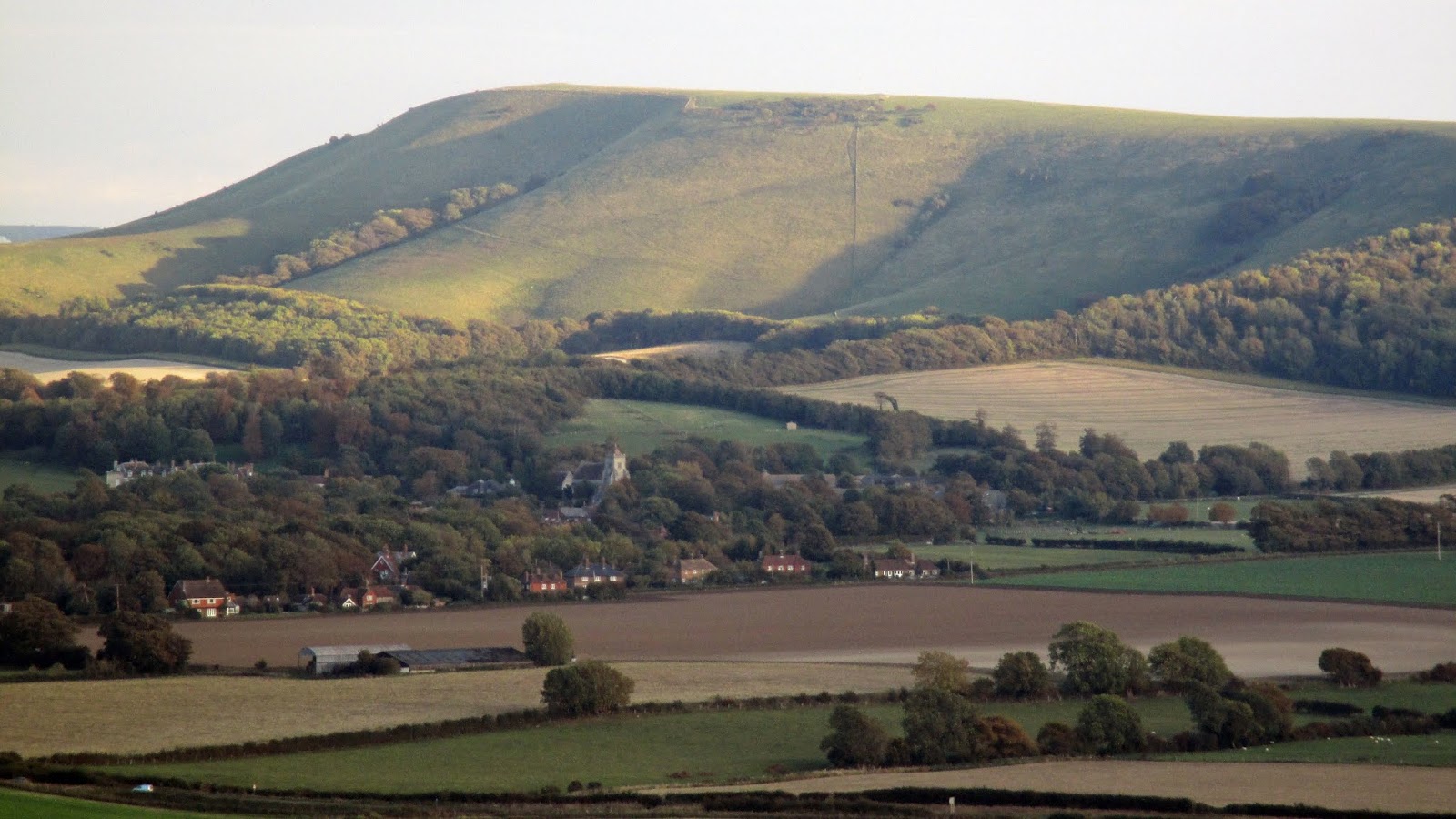
A sinking sun earlier today revealed the many textures - the curves, cuts, shades and stipples - of the Southerham Downs and inspired me to photograph the same thing many times over! The breathtaking view from Cliffe Hill of Bible Bottom, Oxteddle Bottom, Caburn Bottom and up to the ramparts of the old hillfort at Caburn Top itself is one of the finest found in the eastern Downs.

Approaching Caburn


Saturday, 10 September 2016

The Way-side at dusk

Rooks and Jackdaws at dusk

The track - stair-rod straight
The track that links Mount Pleasant with Bishopstone stretches stair-rod straight for about two miles along undulating downland foothills. I suppose it is old and I wonder if it is ancient: along its highest crest it passes a series of earth barrows; in the other direction it passes beneath the metalled surfaces of Falaise and Seaview Road before reverting to rough footpath and plunging steeply downhill to St Leonard's Church at Denton.

It is a footpath, bridleway, rough track, road, a link between settlements, cemeteries and people. It is a wildlife corridor, field headland, a ribbon, a river of life flowing through and beyond barren, harvested fields. This path is not a gash cutting through the landscape, not a wound inflicted by modern farming; it is an artery which carries things through the landscape: feet, hooves, cartwheels, tractor wheels, paws, bicycle wheels, and, during heavy rain, even the eroded chalk powder of the earth itself.

Knotgrass
The path downhill from Mount Pleasant reaches a nadir before rising steeply again above Foxhole Farm; here at its nadir it forms a natural sump where traffic-ground dust is spattered into a heavy paste by late-summer rain, lubricated into a downward flow into the sump, where it collects as a chalky slub. At the turn of each year we call this slub January Butter. Today it is mixed with dried grasses and the manure of passing horses in a sticky, grey daub.

Sussex has a rich dialect when it comes to mud. Sussex roads gained a notoriety for their heavy-going state when Daniel Defoe lamented about them in his Grand Tour, during his struggle through the Wealden clay. My chalky track, high above and to the south of the heavy clay, has been a dry bed for months but, tonight, as I walk along its course, the intermittent rain has softened the harvest dust. Today has felt more in common with October than August and the sticky paste reminds me to be thankful for the dryness of the season and clean dogs at the end of each walk. These dog-days are numbered, but one day of sun and wind tomorrow will bake hard the chalk-rich earth again.

Knotgrass flower
The abundance of plant and insect life in a field headland can be astonishing. The track is still a green life-rich corridor flowing between harvested desert fields, despite September grass sideburns which look long overdue a shave. The bottom of the sump is adorned with a carpet of knot-grass, its deep pile extending down into the restful sediment transported into the sump by forgotten rains. The dominant species, though, is greater plantain, which have poked out thousands of tongues upwards in defiance of the harvest blades, like anenomies greeting a rising tide.

In recent weeks we have been entertained by an abundance of butterflies: meadow browns, gatekeepers, marbled whites and common blues, with the odd wall brown. Tonight though the track has given its greatest gift of the year in a hawking barn owl; not a ghostly white figure but an unmistakable silent silhouette which drifts across the straw stubble away from the pell-mell of my dogs. The same airspace during our morning walk was taken by a hovering kestrel. Further along the track we pause and listen to a tawny owl somewhere below us in The Rookery. A second one answers somewhere lower down in the wood. We haven't seen or heard them here before and we happily add them to our mental list alongside barn, short-eared and little owls which we remember from the thirty or so years past that we have walked here.

Gulls #1
Walking along the track early this morning revealed that the barren fields have been colonised by pioneers: paroled arable weeds free of regimented crops, flocks of rooks, jackdaws, gulls, pigeons and a dozen greylag geese. These are gleaners and grazers. I wonder if these are some of the large skein of about 120 geese I saw making their way along the Ouse Valley a few days before? On that occasion I saw a single mallard punching well above its weight at the front of the V, skein-surfing their bow wave.

Gulls #2
The track has faded to a low glow as we near home. The rooks and jackdaws are making their way back home while, above, gulls are coast-bound in dribs and drabs. A fox chatters and chuckles somewhere within the maize field, but there is no sign of the barn owl. The maize whispers in a low breeze as we pass it and it conjures the illusion of unwanted company. A hushed chorus of dark bush-crickets guides us along. The path is straight and, when we walk through this country, we walk as the crow flies.

Coast-bound gulls

Walking home, as the crow flies

Monday, 15 August 2016

Chafers beneath a full moon


 Everything lost on Earth is to be found on the Moon*, not least the light of day.

The moon is waxing gibbous tonight and, on Thursday at 8.15pm, it will rise full as it does every twenty nine or so days. This event won't be a so-called 'Supermoon' (we will have to wait until November for the next one of those) but the wave of awe in witnessing one of nature's spectacles will sweep across the Earth, like the tidal bulge, and be no less felt in the event of the ordinary full moon moonrise than it is during those occasional superevents. Some feel the draw of the moon more than others, but it is a rare person who is not at all struck by the event whenever the full moon breaks over the horizon and arcs across the night sky.

The night of a full moon is something that we like to celebrate in special places, where a tangible connection between the earth and the heavens might be more strongly felt. Last September, when the full moon achieved supermoon status, hours before it slid into the totality  of a lunar eclipse, we trekked up to The Bridestones which rise high up above the Dalby Forest in the North Yorkshire National Park. We watched the drama unfold as we caught our breath, only to lose it all over again at supermoonrise. Hours later our alarm woke us so that we could take in the eclipse from the cottage garden in Cropton.

Last month's full moon moonrise was one of those occasions when our planets aligned and we had the chance to mark the occasion together. We were at home - this time in the South Downs National Park - and we chose one of the more pagan patches of Down close to home: Combe Hill, which overlooks Willingdon. We chose a favourite circular route from Jevington which follows the gentle progress of the southern downland slope up to the crest of the Eastbourne Downland. This rewards the walker with magnificent coastal views to the south and east before the northbound path carries you onto Combe Hill - itself a constellation of enclosure and satellite barrows or tumuli, which once would have shone their chalk-white light across the land like novae of spent lives remembered, their fading light slowly melting into the downland turf along with the old religion as the parish church replaced the older ways and became the new centre of the human universe.


The moon rose as we passed Butt's Brow. We watched it breach the horizon and climb above the Channel and brighten in magnitude as the dusk stretched its fingers out of the west. There is a near-tactile energy in moonlight which reveals the character of the land - something which is blinded by daylight. History seems to congeal and reanimate, rise up out of the soil and array itself before us in the gloaming. Daytime winds fall away with the light; the synergy of sticky silence, the moonlight and the long line of history crystallise in the imagination in this crucible. The moon is the key ingredient: the light of its fullness casts a reverent spell; reverence of nature, of the land, of the history of the place. The people who have farmed this land, our ancestors, we have all borne witness to this same moon, rising cycle after cycle, lunation after lunation. The moon is part of the glue which binds us. That moment beneath the full moon bears witness to all of history so that it exists as if all of time is captured in the moment. We are the end link in a chain of 200 or more human generations which stretches back unbroken into the depths of time. The connection is strongly felt. How appropriate it is that moonlight inspires within us such a moment of reflection.

The moon is lighting our way in growing influence now as we walk from Combe Hill back towards Jevington. The land is ancient and anything greater than a single ploughshare drawn by a pair of oxen seems out of place. The daylight splendour of the flower meadow is dimmed as the last of the light falls away into the west. As the trees reach up and embrace Neolithic lynchets, swarms of summer chafers envelope us and we marvel at their lunatic dance around the tops of bushes. Thousands emerge from the ground around us as if summoned by the full moon, like terrestrial coral polyps. These are creatures of mid-summer, but often mistaken as Cockchafers ("the Maybugs are late this year", I am told most midsummers). The summer chafer's scientific name is Amphimallon solstitale, the latter meaning 'of midsummer', of the solstice. Known also as the June Bug, it is a beetle which swarms at dusk, sometimes in impressive numbers. Much smaller than the cockchafer, it has a habit of flying aimlessly and harmlessly around you, and bouncing into you, with a fierce-sounding buzz, before attaching itself to clothing and bare skin. The worst it can do is cling on and make a nuisance of itself with its remarkably strong grip, but even then it is painless to remove. As we walk along, more than a dozen alight on my arms, legs and head, some in copulating pairs, like a scene by Bosch, sent mad by the moon above.

The chalk path leading back out of the dreamy landscape was painted silver. We approached Jevington through the pasture at Cloth Farm feeling vaguely aware of our insignificance. The life-giving moon, sister of the Earth, without which there would be no tides, no seasons, has waxed full and waned again month after month, gazed upon by countless species on the land and, for longer still, within the seas, and back further still into deep time. Our link and the two hundred stretched out behind us are an insignificant eye-blink, and yet we do live in significant times. We humans are at our most destructive when money is not plentiful. In these uncertain times important decisions are made which sometimes carry catastrophic changes. The stunning Eastbourne Downland is up for sale. The local Council can raise a few million pounds from the sale. This might usher in a greater change to the landscape than has been seen since the land was first farmed. The new owner of the land here might recognise their importance as stewards of this ancinet landscape. They might recognise in the real light of day the importance of a commitment to manage the land in its time-honoured way: sensitive grazing after the summer carpet sets seed. If Eastbourne Borough Council cannot make this commitment on behalf of the people, the land is better off in safer hands, but the moonlight can be deceptive and instil fears which may prove unfounded. 

Ushered back to the village by the hooting of tawny owls and buzzed by tutting pipistrelles, we agree that for all its beauty, the dark light of the moon can cast many spells, some of which leave us feeling less certain. 


*"Everything lost on Earth is to be found on the Moon" is taken from Ludovico Ariosto's epic poem of 1532, The Frenzy of Orlando (Orlando Furioso).

Thursday, 4 August 2016

Summer in the Bronze Age

The rough road from Jevington along the old Eastbourne Road up onto the top of Willingdon Hill begins in shade. I have all three dogs with me today, already half-worn out by a circular walk around Crowlink, and they seem grateful for the relief offered by the shade of the overhanging trees from the sun and gentle breeze. The landscape is peppered with ancient landmarks and, as the track emerges from the trees the landscape unfurls to reveal not only medieval and Roman workings, but Neolithic barrows and earthworks more than five thousand years old. Man and the soil have here been intertwined for 200 or more human generations.

The track is sunken as we make the gentle and steady uphill climb, excavated by centuries of grinding hooves, feet, cartwheels and rainwater, its run-off ferrying the powdered chalk, mud and stone sediment downhill in a greasy glut towards the village. Imagine the tons of spoil carried in its flow when the track is scoured clean during a deluge. The banksides are alive with flowers: bedstraws, vetches, knapweeds, hedge-parsley, wild carrot and hogweed. The air, despite the faint breeze, is filled with the scent of hogweed and, despite there being something reminiscent of the public convenience about it, the scent conjures deep-rooted memories of feral summer holidays. Hogweed is, to my nose, matched in its power to kindle memories only by the scent of wild privet. The wheat field to the left is bending its harvest head towards the farmer, the airy roar of his machinery now only a field or two distant, although the smell of straw as I pass has not yet lost its greenness. The top of the wheat field has been desecrated by a starry cluster of flowering sow-thistles, which have climbed their way above the crop and are now nodding ten thousand mocking suns upon the ears. The pattern of infiltration suggests the neighbouring hay field was cut late the previous year in a light easterly which sent the seed-heads gently foaming across the field boundary.

At the top of Willingdon Hill a circular mound marks the former location of a windmill; from here the view stretches south beyond Warren Hill towards Beachy Head. This crest of downland forms the eastern extent of the South Downs and its Way. The landscape is typical of the South Downs: a gently progressive rise from the sea until a crest is reached and then a dramatic escarpment to the north in which all progress from the sea is lost as it falls into the low Weald in no more than a few tens of metres, like a breaking wave frozen in time. The north-side escarpment here is wooded mainly with Ash. To the south the crest of the trees show the characteristic bare-bones of the Chalara Ash dieback, a chronic fungal disease caused by the fungus Hymenoscyphus fraxineus, which has become more conspicuous this year. The bare, cresting canopies remind me of the withers of an old horse.

My route is to the north, where I shall follow the South Downs Way for a short distance before swinging back down towards Jevington. From the windmill mound Butts Brow is visible ahead of me and the Neolothic enclosure on Combe Hill just beyond and above it. This causewayed enclosure, which stands at the top of the escarpment, has tumuli to each side. These barrows once would have been tended to keep them clear of grass. The bare chalk would have glowed for miles across the Downs from clearings amongst the trees like stars in the night sky, each one a nova, a memory of a Neolithic woman or man whose star has waned, to be gazed upon by the string of descending generations. One of these barrows, when excavated, revealed a stone slab which, when lifted, revealed beneath it the remains of four broken bronze axe-heads. There is much debate about the function of hilltop enclosures. Archaeological remains of wooden post holes in some locations suggest a palisade fence which might just as likely have been intended to keep things within rather than out: summer-grazing livestock folded overnight within the sanctuary. This is, after all, an ancient-farmed landscape.

The land between Willingdon and Combe Hills is dry and harsh, flinty. A small murmuration of mainly juvenile starlings has been fidgeting from fence to field as we progress, troubled perhaps by our small party. A dance in several movements is enacted before we pass beyond them and onto softer terrain to the west. The land here is part of the Eastbourne Downland - land held in trust by the local authority. Tenant farmers work the land with sensitive grazing made only after the summer flowering period. Continuity of this practice over many decades has produced one of the finest wild flower meadows I have seen: countless species suddenly surround us - squinancywort, self-heal, eyebright, rock-rose, rest harrow, marjoram, wild thyme, hawkbits and hawks-beards, scabious, medick, clovers, arching spikes of agrimony, heathery bartsia, low-growing grasses, most of which are an enigma to me, but I think I can recognise quaking grass, some oat-grasses, cat's-tail (timothy), meadow-grass. How sad I was to learn the other day that this land has been put up for sale by the local council. It feels good to walk bare-foot across this good turf, the downs becoming ingrained into the contours of my feet - the connection with the land feels more complete; I feel earthed.

A few swifts are scything their way through the air above me, silent and making ready for their journey south. This year's fledglings will remain on the wing continuously for two years, when they are sexually mature. Two years of feeding and sleeping and everything on the wing! When they are ready, they will collect nest material, build it and even mate on the wing. The parson-naturalist Gilbert White, in his classic Natural History of Selbourne, speculated that swifts spend their winters beneath the sea. If these mysterious birds were seen to head out into the big blue and disappear into the horizon, perhaps this speculation was not as laughable as it may appear to the modern reader. I speculate myself whether White imagined a flying fish-like chimera, half bird, half fish, skimming the sea before delving beneath the waves, beneath the horizon, to spring forth into the air again ahead of the following year's bowsprit.

Close to Jevington village several lynchets form a Neolithic or Romano-British field system. These are the dominant landscape feature when viewed from the Eastbourne Road earlier in the walk. They show how the slope of the field was made less steep to enable less arduous cultivation. Scrub is now encroaching across the strips of land between the mounds. How long since they were last worked? The short foot-worn grass of the path above the lynchets is littered with ears of wheat, evidence that crows have been collecting their share of the harvest ahead of the farmer. One could be forgiven for thinking that children had plucked the tops and arranged them along the path. Only a tiny share of the wheat is taken and it saddens me that farmers feel the need to persecute these intelligent birds, even though they help the farmer at other times of the growing year by predating on crop and soil pests, as well as plundering other birds' nests for eggs and chicks. A farm between Rodmell and Southease shoots and strings-up dead corvids on stakes in a field by the roadside - a shocking sight, but a practise that has some effect because the crows do seem to take notice and feed elsewhere. Records of crow persecution are held in many parish churchwardens' accounts dating back to the first of the so-called Tudor Vermin Acts in 1532, although the killing undoubtedly stretches back way before grain was first protected by Royal decree, when not sharing the harvest while in the grip of the Little Ice Age could have reduced the likelihood of starvation, malnutrition and death.

Efforts to cull corvids never succeeded (intensive use of insecticides after 1945 was much more effective) and, to prove it, the local rookery now takes to the air before me in a wonderful cacophony: rooks and jacks wheeling up and around the church and back into the trees, with only a few breaking off in a sortie to pursue and harry the passing buzzard.

The noise settles to leave only the soft hush of ash leaves and the chatter of a charm of goldfinches, who usher me and three tired boys back through a hay-cut field, bearing on its fallen stems the empty pupal cases of fledged burnet moths, back from the Neolithic, through Romano-British and medieval, pagan and Christian, sacred and profane daydreams to Jevington - the jewel of these ancient downs.

Monday, 6 June 2016

An invasion of the Diamond-back Moth

May 2016 in Newhaven felt decidedly average when considered from a butterfly and moth perspective - until after the 29th. The final two days of the month saw an explosion in numbers of a tiny migrant micro-moth species: the Diamond-back Moth Plutella xylostella.

Individual Diamond-backs began to appear in my garden moth trap this year from 6th May and continued in this manner every few days until 23rd, when they disappeared for a week. Then, on 30th, I saw twenty. The most I had ever recorded during one night before was 64, so twenty individuals gained my attention as it was a comparatively noteworthy number. The nights following this produced the following numbers:

31st May: 175 individuals
1st June: 138 - after which I expected the spike in numbers to gradually regress back to the mean
2nd June: 382
3rd June: 437
4th June: 1740
5th June: 411
6th June: 360

To place this in some form of perspective, I had recorded a total of 881 Diamond-backs during the previous ten years. This was by no means a high number compared with many other coastal stations, but it is the number which I had recorded at home in Newhaven, and that figure is therefore a useful datum for comparison. In five nights from 30th May that total was comprehensively eclipsed and I recorded 1152 individuals; this total was itself eclipsed on the night of 4th, bringing the total in six nights to 2892! This total did not include the few hundred Diamond-backs seen resting and possibly nectaring on a flowering Cordyline in my front garden on 2nd June; it did not include the 2000+ individuals (a conservative estimate) which I saw on the evening of 3rd while walking from home over the apex of the Downs along the east of the Ouse Valley to Bishopstone - a distance of just over one mile as the crow flies; it did not include many hundreds more seen on 4th along a well-known spot for migrants on the Downs above Denton and Poverty Bottom. It was at this latter location that the scale of this invasion occurred to me. How does one count a tiny micro-moth flitting about here there and everywhere in such great numbers that, for every one seen, another ten - another thousand? - pass unseen? Add to this a carpet of buttercups which spread before me across 45-odd acres in a lurid nebula and the task appeared even less attainable. Counting the buttercups would have been less of a challenge. I gave up. I simply enjoyed the spectacle before me.


Diamond-back Moth Plutella xylostella
So what is the Diamond-back Moth? It is a member of the Plutellidae family of moths. There are seven species found within the UK, but only three of these are found in the south east and all of these have been recorded at Newhaven: the Diamond-back, the common Grey-streaked Smudge (Plutella porrectella) and less common Bittercress Smudge (Eidophasia messingiella). Each of these species feeds on plants of the cabbage family. The Diamond-back is a small species: about 8mm in length at rest. It is a neat-looking insect, with a long-thin body around which the wings are folded roof-like when at rest. It has an alert upright resting posture and its antennae are forward pointing, much like its migratory attitude. This moth is a visitor from the continent each year and it is seen in variable numbers from one year to the next. In observing the flight of this species, it is a remarkable thought that they make it across any stretch of water, but this they do, presumably at high altitude, before making landfall in the UK.

Being based on the south coast at Newhaven and only about seventy miles from continental Europe (the French coast between Fecamp and Dieppe is nearest), migrant insect species are both a staple of life every year for the Lepidopterist and a fascinating area of study. The Ouse Valley and Downs to the east are a fairly reputable station for migrant sightings. The Willowherb Hawk-moth (Prosperpinus prosperpina) Oleander Hawk-moth (Daphnis nerii) sightings of 1985 and 2014 respectively are probably the best examples, but getting on for forty migratory moth species have been recorded in Newhaven during the past ten years and these have included occasional sightings of Crimson Speckled (Utetheisa pulchella), regular small numbers of Olive-tree Pearl (Palpita vitrealis), Vestal (Rhodometra sacraria), Gem (Nycterosea obstipata), Ni Moth (Trichoplusia ni), and very good numbers annually of Bloxworth Snout (Hypena obsitalis), which, along with several other migrant species, has begun to colonise along the coastline. Silver Y (Autographa gamma), Red Admiral (Vanessa atalanta) and Diamond-back are the most commonly encountered on a yearly basis, but migrant species are well known for their episodic spikes in abundance during specific continental immigration events. One famous recent example was seen in 2008 when many millions of Painted Lady (Vanessa cardui) butterflies migrated northwards from the Atlas Mountains of North Africa as far as the Arctic, the generations leap-frogging each other as they progressed. 

Most of these and the other migratory species are seen during periods of strong winds from the south, but immigration events occasionally occur from other directions and the current Diamond-back invasion appears to be one such example of an immigration from the east or north east. The spike in Diamond-back numbers which began during the final two days of May appears to be the greatest immigration event by that species and it might yet prove to be amongst the most significant of migratory episodes observed during the past 170 years, when formal recording began. Bearing in mind that these moths will breed following their arrival, we could be in store for a second bonanza later in the summer.

Diamond-back Moth at Castle Hill LNR, Newhaven

Sunday, 1 May 2016

Psychogeography: the Peacehaven promenade as palimpsest

We determined to walk in about one hour the entire length, west to east, of the Peacehaven Promenade; not the windswept postcodes sitting high and dry along the cliffs above, but the sea defence: the brutalist concrete purdah which has veiled virginal white chalk cliffs from the furtive winks of the ruinous sea these last four decades.

We had astutely parked one of our two cars at Cliff Avenue - a psychogeographic derivation and terminus if ever there was one - and continued abreast westwards to the southern and rocky extent of Cairo Avenue, a namesake which conjures no comparison on this cold and windy day other than to suggest that this was our entry point, via the adjacent Howard Park slipway, to a maritime desert bereft of wildlife. We would descend and walk with the strong, cold, salt-laden wind at our backs back to the four steep flights of narrow steps beneath Cliff Avenue, inspecting as we did so fifteen lifebelts for their potential to offer asylum from the waves to any soul unfortunate or reckless enough to find themselves in need of extrication.

The defences have succeeded not only in prohibiting the eroding forces of sea and tempest; the non-human world has here also been made taboo, at least when the tide is high. The only exceptions to the intermittent staccato herring gulls and fulmars wheeling bereft and ledge-less above us were a lone rock pipit clinging grimly to the near-vertical concrete face, hunting for invertebrates (which, if they had once been present, had been blown elsewhere and eastwards by the wind), a single and rather magnificent pill woodlouse (Common or Southern I did not establish) hiding within the housing of a lifebelt and the occasional outcrop of garden-escaped wallflower and tree mallow and some other low-growing vegetation with which I was not familiar. This is not so much a hinterland separating the marine and terrestrial worlds as it is a vacant, sterile metropolis.

The promenade runs parallel to the base of the cliffs in a ruthless coastal parody and in affirmation of man's dominion over savagery. No doubt entropy will have its way, ultimately, but for now the Channel storms' only protest is to hurl stones onto the smooth roadway. These are periodically sucked up by the Council's Scarab (accessed via the Cairo Avenue slipway?) and redeposited, it appears, on the ramps which otherwise allow vehicular access to and from the shingle shelves that abut the concrete. In keeping with the psychogeographic theme, this tit-for-tat between storm and scarab creates a palimpsest which this winter would have been daubed in turn by Abigail, Barney, Coldagh, Desmond, Eva, Frank, Gertrude, Henry, Imogen, Jake and Katie. They all woz 'ere, but the scarab subsequently wiped clean all evidence of their presence and taught them all that resistance is futile against the concrete resistance laying between the sea and the chalk, whose Downland surface high above our heads sympathetically peaks and troughs its way inland.

Interactions are few as we gait our way eastwards: we pass a handful of intermittent dogs and walkers, including a blue-coloured Staffordshire preoccupied in carrying in its puissant mandibles a similarly coloured and similarly-sized flint pebble, both apparently equally hard as nails; also, a rather fearsome, mischievous looking mastiff cross which thankfully is kept on a short tether, presumably for the benefit of all others as well as its own. Passed also are a pair of young adults kicking a ball into but not past the impenetrable concrete defence. A lone jogger jounces her way past eastwards and, moments later, westwards. With only one cheerful exception, all these people are recondite in solitude, cast adrift by choice onto their personal islands. None seem curious about the fact that we stop at each lifebelt to inspect and photograph it. If we threw one at them, remembering to keep hold of the end of the rope, they would probably not even trip over it, let alone throw it back at us. So we don't.

We complete our promenade in just short of seventy minutes. The waterfront is replete with lifebelts ready for use, should they ever be required. We turn our backs to the sea and ascend the cliff to Cliff Avenue. One day the battles won by the concrete and the scarab over the softly, softly eroding sea and storms will be forgotten. It is an awesome consideration that the sea has on its side the entropic forces of time. Victory in battle, imagined or real, is nothing when one knows that the war will have only one victor. In arresting the successive forces of nature, we humans can win only a stay of execution. Nature always finds a way.


 ***

The Monotony of Safety


The reds go marching on


Take the cliffs to Cliff Avenue