Showing posts with label damselflies. Show all posts

Saturday, 23 June 2018

White-legged Damselfly


The pond at Piltdown


We ventured north of the district yesterday in search of the White-legged Damselfly (Platycnemis pennipes). These elegant, feather-legged little damsels like to bask on abundant floating vegetation and the pond at Piltdown, which has caught my attention while driving past, looked a promising site.
My reason for hunting ‘featherlegs’ is to contribute to a survey that’s been organised by the British Dragonfly Society: the White-legged Damselfly Investigation. The point is to learn more about this species and add to our limited understanding of it. There are increasing concerns that this dainty little insect is in decline in Britain. More information about the survey can be found here.

The very first damsel I focused my binoculars on was a White-legged Damelfly, a male on an iris leaf manoeuvring its abdomen in the fashion of an ovipositing female. On closer inspection it was stuck to some spider silk. Once freed it stood on my finger for a few moments before gently alighting half a metre to another iris, where we both lingered for a little while.

The pond didn’t disappoint; it was alive with seven damselfly species, basking on what seemed every blade and leaf of vegetation. Black-tailed Skimmers patrolled the banksides while teeming Swifts screeched above them. Two hours later I had seen eight damselfly and dragonfly species, along with a few other species of interest.

Rutpela maculata long-horn beetle

Species seen:

Odonata (eight species) 
 Banded Demoiselle (Calopteryx splendens)  2
White-legged Damselfly (Platycnemis pennipes)  2
Large Red Damselfly (Pyrrhosoma nymphula)  2
Blue-tailed Damselfly (Ischnura elegans)  29
Common Blue Damselfly (Enallagma cyathigerum)  5
Azure Damselfly (Coenagrion puella)  120
Red-eyed Damselfly (Erythromma najas)  5
Black-tailed Skimmer (Orthetrum cancellatum)  12

Lepidoptera (eight species)
Nut Leaf Blister Moth (Phyllonorycter coryli)  - mines on hazel leaves
Large Skipper (Ochlodes sylvanus)  3
Large White (Pieris brassicae)  1
Small White (Pieris rapae)  4
Green-veined White (Pieris napi)  2
Ringlet (Aphantopus hyperantus)  1
Meadow Brown (Maniola jurtina)  1
Comma (Polygonia c-album)  1

Coleoptera (one species)
Yellow and black Longhorn Beetle (Rutpela maculata) 2

White-legged Damselfly (Platycnemis pennipes)

Blue-tailed Damselfly (Ischnura elegans)

Thursday, 21 July 2016

Alfriston Clergy House: a sanctuary of stability


After two hours spent at the beach this morning, I was ready by midday to beat a retreat. The temperature was passing 30°C - the hottest day of the year so far. The advice was to drink lots of water and stay in the shade and to close blinds to help keep your home cooler. Alternatively, sometimes it is cooler still to leave the house and sit beneath a tree. That was all the encouragement I needed.

I have been nursing a bruised rib - the result of an accident involving a metal five-barred gate and a reluctant dog. The pain is blossoming with each day, so my plans for some 'epic' walking this week have been painfully deferred. Just as well, perhaps, given the heatwave that most of us are enjoying. A gentler pastime was required and my preferred choice of venue today was The Clergy House at Alfriston, where I intended to lose myself in a book in the shade for a couple of hours. "Have you visited us before?", asked the helpful guide. "Yes." "Ah, well you know what you're doing then!" I did; I had a couple of books under my arm and no intention to enter the cool of the 14th-century hall and instead headed for the cool of the garden.

I chose a shaded spot between a hawthorn and grey willow and by a stream edge which forms the back border of the property. A blue-green screen of Phragmites reeds and blue sky was all I could see when seated on the ground. There were no distractions and I intended to absorb myself within one or both of my books. The water was a hive of activity: whirligig beetles and fish fry meandered on and just below the still surface while a banded demoiselle - a beautiful emerald female - and blue-tailed damselflies danced just above it, resting for a moment on the reed stems. As I settled a large fly alighted on my leg (my body heat no doubt a glowing beacon). The fly looked like a picture-wing fly on steroids and I recognised it as one of the deerflies - members of the horsefly family. The part of me that likes to know everything there is to know nearly persuaded me to allow the deerfly to rest long enough to photograph it for identification later, but common sense won over before the fly gorged upon my blood. Although their fearsome reputation is well-earned, they are nonetheless beautiful, striking flies, and particularly so their eyes. It got the message and disappeared, presumably to some unfortunate livestock nearby.

A moorhen broke the silence with an explosive shriek, made me start, revealing its presence amongst the reeds just a few feet before me. A female mallard, the subject of the moorhen's scorn, hurriedly exited the reeds. A Cetti's warbler echoed the alarm a few moments later with its overloud aquatic gurgle, while a gentler reed warbler sang amongst the reeds somewhere unseen. This was the peaceful oasis I had hoped for. Two or three red admirals patrolled energetically above me while a skipper, meadow browns and various whites skimmed and floated back and forth. A mixed group of long-tailed, blue and great tits moved its way through the grey willow, one long-tailed tit venturing to within an arm's length of me, fearless, while inspecting one of the lower branches. I could hear some greenfinches in the canopy above and, above all I heard the cries of swifts as they scythed through the unbroken big blue, and then swallows too at a lower altitude. The air was almost still and carried the scents of subtly stagnant water and straw and intermittent sounds from the middle distance: occasional drones of light aircraft passing overhead, a farm vehicle being manoeuvred (a harvester?) and the bellicose boasts of distant woodpigeons. These sounds swelled and fell away, rose again and receded to leave just the hush of the reeds in the slightest air. All was well and I imagined how the protective embrace of the National Trust ensured this soundscape from day to day, year to year, and was thankful for this tiny pinprick of biodiversity. I laid back on the grass, in the shade of the hawthorn, and dozed.

I recalled a couple of news stories I had heard  in recent days on the radio which reported that the world's biodiversity had been found to have entered an unsafe level of decline and that June 2016 was the fourteenth month in succession that global temperatures have risen to a new record high. The usual warnings were given about climate change, global warming, rising sea levels, the loss of pollinating insects and the threat that ecosystems are becoming unable to support human populations. There is a serious concern that many people hear, watch or read these headlines without much thought about what this means in practise. It could mean not only hunger but starvation and thirst, not only illness but death, not only the collapse of economies but the collapse of societies, conflict for resources, riots, warfare, displacement, famine, disease, and ultimately silence. People cannot be blamed if the reality beyond the headlines cannot be grasped: we are consumers who have been failed by successive governments and exploited by big business, hell bent on reaping the fruit of their neoliberal endeavours without considering the costs to the environment and to successive generations. The public feel misrepresented, abused and lied to. We have become cynical and have lost faith that our leaders will work in the long-term interests of the environment and all who rely on healthy and functioning ecosystems. We feel powerless, disenfranchised and resentful. We have been spoon-fed summer movie blockbusters in which natural disasters have destroyed swathes of the Earth. Has this contributed to a numbness felt to the threat of Armageddon? In an age of instant gratification, global climate change occurs at too slow a pace or on too distant a shore for us to notice it. Do we literally have to wait until our feet get wet or until our stomachs cramp with hunger or until our doctors tell us there is no longer a cure before we demand of our politicians that action is taken or make personal changes to our consumption? I fear that this will be the threshold for change, but it will by then already be too late. Some island states will already have been claimed by rising sea levels, their populations made environmental refugees and immigrants shifted elsewhere (but not here!).

Some things need rescuing: the Clergy House in 1893, prior to its acquisition
The National Trust's full name is the National Trust for Places of Historic Interest of Natural Beauty. It was established in 1895 and the Alfriston Clergy House was its first acquisition, in 1896. It is a tiny property and this is a tiny dot amongst the 985 square miles of land holdings within its property. Other significant land owners in the United Kingdom include the Forestry Commission, the Ministry of Defence, various pension funds, utility companies, the Crown Estate, the RSPB, the various Wildlife Trusts and, in Scotland, the Scottish National Trust, the Duke of Buccleuch and Quensberry Estates and the Duke of Atholl's Trusts. Most but not all of these land owners engage in large-scale conservation and protection of their properties. This amounted to 9533 square miles in 2010, which is about ten percent of the UK's total land area of 94060 square miles. Only 6 percent of the entire UK falls within the greater protection of Sites of Special Scientific Interest (SSSIs). Most of these and other 'benevolent' land ownerships are tiny pockets - islands of biodiversity - and, however rich they may be in biodiversity (and not all SSSIs are), they are too small and too fragmented and management strategies are not always successful or properly funded. Land uses between these ‘islands’ prevent the formation of green corridors which might link the dots together and allow the safe migration and genetic mixing of species. Fragmented populations and genetic bottle-necks are much less resilient to shocks and stressors - stressors which include unseasonably warm winters and extreme rainfall, early plant flowering seasons and droughts, changes in land use and even neglect of habitats and scrub growth.

Newhaven is a microcosm of this effect: for all its industry and commerce, the town has a relative wealth of 'open spaces' and wildlife reserves, including the 'three peaks' of Castle Hill, Meeching Down and Bollen's Bush, where rare examples of chalk heath exist, and others such as the Valley Ponds, Riverside Park, Drove Park, and the manicured Hugget's Green, a field at Bay Vue Road, Avis Field the cemetery and churchyards, and the recreation grounds at Fort Road, Lewes Road and South Heighton. These are not linked by green corridors. Areas of open land which might be used to create green corridors, such as that between Court Farm Road and the Newhaven Academy (Tideway School), are earmarked for development. Even the metalled surface of a road is an insurmountable obstacle to many species such as plants, amphibians, reptiles and small mammals. The result is a series of fragmented 'island' communities which are less resilient to those environmental stressors listed above. 

In 1920, following restoration - little has changed in 100 years
When properties such as the beautiful, serene, little oasis at Alfriston are visited, often at times of stunning weather, one can be fooled into believing that the climate change deniers are right and that our wildlife is not in peril. But how many cuckoos were heard from the garden of the Clergy House this year when compared with that of one hundred years ago? Back then, did the trill of the turtle dove add another layer to the soundscape? How long since it was last heard here? Or the plop of the water vole? Things disappear very quietly and often without notice. It seems such a good idea to build over that piece of rough ground to relieve the need for more roads or parking or houses; but with the loss of those plants was also a field full of crickets, moths, flies and other insects which fed the spiders and voles and bats and birds. Those and other species were displaced and plunged into conflict with other populations for ever dwindling resources. We do not see or hear this happening; we don't see their decline; some of us don't understand; many do not care. As a society we will not realise the peril of this situation until we are engaged in the same conflict amongst ourselves - and by then we will also starve, fight and die. I feel there is no guarantee that even then we will see the error of our unsustainable ways and put things right. It's just not in our nature, collectively, to do so. Vested interest may yet see our demise. 

Back by the bank of the stream, the alarm call of the moorhen brings me back awake with a start. National Trust properties are special places of stability and good management. They hold in trust many historic and natural places. It is hard to imagine that the scene at the Clergy House has encountered much in the way of change during the past century, other than the decline in the soundscape of horses and carts and the rise of mechanisation. Most of the creatures are still present, but some have declined and some have disappeared, mostly unnoticed. The reed warbler twitches through to the front of the reeds and reveals itself. Above me a parent great tit is calling insistently to her fledglings and, after a minute or two of concern, they assemble and fly off together, safer in their family group. The hush of the reeds is the one constant. It is as though they are trying to bring something important to our attention.

References:  

Biodiversity falls below 'safe levels' globally, Imperial College London, 14th July 2016.

Hottest ever June marks 14th month of record-breaking temperatures, The Guardian, 20th July 2016 

Thursday, 2 June 2016

Late May at Newhaven's Castle Hill Local Nature Reserve

Week 8 of the 2016 transect-walking season at Castle Hill LNR

 
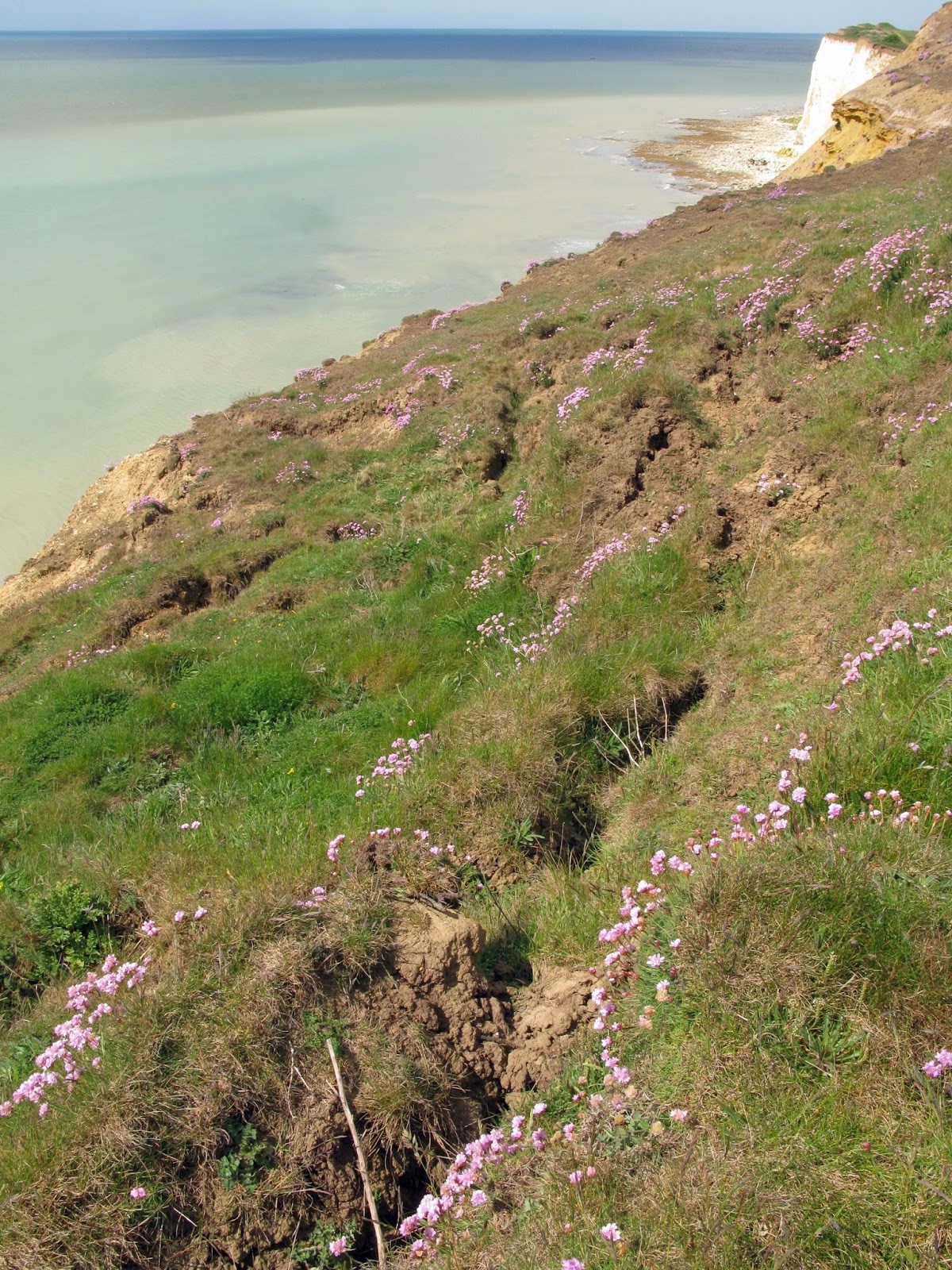
Thrift in bloom at Castle Hill LNR

The final week in May was not remarkable for butterfly activity across the nature reserve, but it was for moths, with seven new species being seen for the first time at the site. This raises the species list for butterflies and moths to 339. The weather was not ideal and the wind and cloud kept some species from being active. Amongst the butterflies, the Green Hairstreak (Callophrys rubi) continued to show well and it seems this impressive metallic green insect is having an excellent season as it continues to become more established across the nature reserve. This was a rare sight a few years ago, but it has been one of the commoner species seen so far this year (although this is partly because it has been a poor year so far for many of the other butterfly species). Wall (Lasiommata megera) can now be seen along the grassy apex of the reserve to the west and east of the Lookout. This butterfly is a specialist of chalk downland and is always a pleasure to see at Castle Hill.

Moths were seen in good numbers this week, but these were mostly 'micro-moth' species which require a close search. It is well worth taking the time to search for these around the woody areas of the reserve though because you may be rewarded with the sight of a spectacular Sulphur Tubic (Esperia sulphurella) or Common Tubic (Alabonia geoffrella). Nine of the species seen belong to the large family of moths known as Tortrixes. Tortrix species fly at dusk and on calm, overcast days, as well as at night. The family has about 440 members, so it is one of the larger families. Forty four Tortrix species have now been recorded at Castle Hill - only another 90% are now left to find!

One of the new additions to the site list is the Cocksfoot Moth (Glyphipterix simpliciella). This is one of the smallest but most common of the British species. David and I saw an estimated ten thousand of these moths in a few hours between Lewes Racecourse and Mount Harry in Lewes some years ago. Where they are present, they can be found on the heads of yellow flowers such as buttercups, with a dozen or more nestled in a single flower-head. They are easy to find, abundant, but curiously absent from some areas where one might expect to find them. My personal opinion is that they have a preference for low-nutrient, poor-quality soils (such as chalk grassland), where the diversity of flora is greater. It is therefore a relief that this previously absent moth has finally turned up at Castle Hill after many years fruitless searching.

Other insect orders were seen in good numbers during the survey. Most of these are not counted so that attention can be focused on the butterflies and moths, but some regular species are included in my count such as dragonflies and damselflies, Heteroptera 'true' bugs (e.g. shield-bugs), some beetle families, crickets and grasshoppers. Bees, wasps and hoverflies are left for other, more knowledgeable, recorders to work on!

A dragonfly and plenty of damselflies were seen, mostly around the damp, scrubby areas on the north-facing slope - including an example of the Variable Damselfly (Coenagrion pulchellum), which it is believed is another first for Castle Hill LNR. This is a species which has a scattered distribution over England and Wales, but it is much more widespread in Ireland. It is an excellent addition to the site list and I hope that more are seen. Careful attention needs to be given during identification in order to separate it from Azure and Common Blue Damselflies.

Variable Damselfly (Coenagrion pulchellum)

Week 8 species list


Butterflies (10 species)
Large White (Pieris brassicae)  2
Small White (Pieris rapae)  6
Green-veined White (Pieris napi)  1
Wall (Lasiommata megera)  2
Speckled Wood (Pararge aegeria)  6
Small Heath (Coenonympha pamphilus)  2
Red Admiral (Vanessa atalanta)  1
Green Hairstreak (Callophrys rubi)  9
Common Blue (Polyommatus icarus)  5
Holly Blue (Celastrina argiolus)  3

Moths (22 species)
Mullein (Shargacucullia verbasci)  3 larvae
Silver Y (Autographa gamma)  1
Mother Shipton (Callistege mi)  1
Small Purple and Gold (Pyrausta aurata)  1
Straw-barred Pearl (Pyrausta despicata)  1
Lackey (Malacosoma neustria) 2 larvae
Mottled Pug (Eupithecia exiguata)  1*
Fruitlet Mining Tortrix (Pammene rhediella)  2*
Grey Gorse Piercer (Cydia ulicetana)  22
Red-barred Tortrix (Ditula angustiorana)  1*
Yellow-spot Twist (Pseudargyrotoza conwagana)  1
Common Marble (Celypha lacunana)  3
Marbled Orchard Tortrix (Hedya nubiferana)  1
Knapweed Bell (Epiblema cirsiana)  2*
Silver Carrot Conch (Aethes williana)  1
Light Brown Apple Moth (Epiphyas postvittana)  1
Sulphur Tubic (Esperia sulphurella)  3
Common Tubic (Alabonia geoffrella)  3
Common Nettle-tap (Anthophila fabriciana)  7
Apple Leaf Skeletoniser (Choreutis pariana)  1*
Cocksfoot Moth (Glyphipterix simpliciella)  1*
Gorse Case-bearer (Coleophora albicosta)  1*

*new species - not previously recorded at Castle Hill LNR

Damselfies and Dragonflies (6 species)
Large Red Damselfly (Pyrrhosoma nymphula)  1
Blue-tailed Damselfly (Ischnura elegans)  1
Common Blue Damselfly (Enallagma cyathigerum)  1
Variable Damselfly (Coenagrion pulchellum)  1
Azure Damselfly (Coenagrion puella)  11
Hairy Dragonfly (Brachytron pratense)  1

True bugs (4 species)
One of the Mirid bugs: Stenodema laevigata  6
Gorse Bug (Piezodorus lituratus) 2
Dock Bug (Coreus marginatus)  54
One of the Rhopalid bugs: Corizus hyoscyamii  1

Beetles
Thistle Tortoise Beetle (Cassida rubiginosa)  14 – mostly seen on broad-leaved low plants (e.g. burdock)
Common Cardinal Beetle (Pyrochroa serraticornis)  4

Crickets and grasshoppers
Speckled Bush Cricket (Leptophyes punctatissima)  2 nymphs

Flora
Ragged-Robin (Lychnis flos-cuculi)  2 plants in the ‘Friends Glade’ near the lower car park

Lackey (Malacosoma neustria)
Marbled Orchard Tortrix (Hedya nubiferana)

Thistle Tortoise Beetles (Cassida rubiginosa)


Green Hairstreak (Callophrys rubi)


Marbled Orchard Tortrix (Hedya nubiferana)  and the stunning Rhopalid bug Corizus hyoscyamii


More bugs: Gorse Bug (Piezodorus lituratus) and Dock Bug (Coreus marginatus) 

Common or Red-Headed Cardinal Beetle (Pyrochroa serraticornis)
Cliff-top erosion along western part of reserve
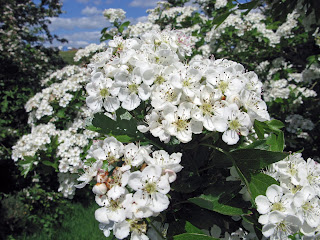
Hawthorn or May blossom (Crataegus monogyna)
Flowering umbellifers along northern track