Showing posts with label flowers. Show all posts

Tuesday, 2 October 2018

Heartland Walks #3: Ghosts of the Harbour


Familiarity leads not to contempt, but to renewed astonishment.
With familiarity, from the known is yielded the unknown, the seen the unseen, the heard the unheard.
A flood of the senses by the rising ghost tide.


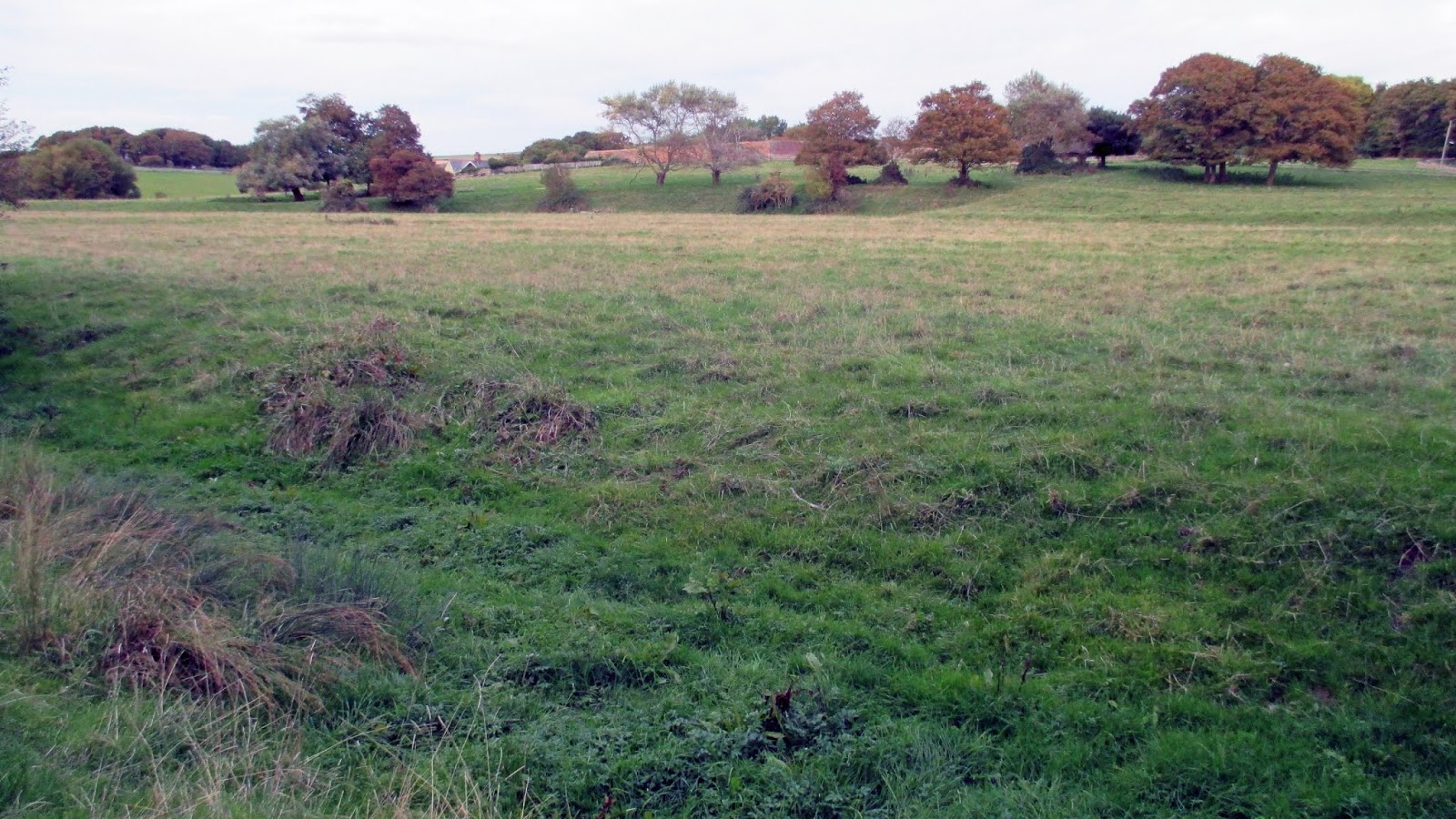
The artist Simon Lewty wrote that "the same walk can mean something different each time it is made, so that familiarity may not lead to contempt, but to renewed astonishment, as the known yields up the unknown"1. I felt renewed astonishment with my discovery of the relics of the old tidal harbour at Bishopstone, the scars of the old creek that run in a loop which joins the dots of five ponds in what is now a damp pasture. Countless times have I walked around this meadow and many times have I looked and wondered at its curious ditches and embankments, but always only in isolation and never before seeing it as a whole system, a system which carries downstream, away from the village and on towards The Buckle, beyond the causewayed coast road and Seaford branch line, beyond into the scars of the old Ouse, towards the sea.

The shallow cleft has been present every one of the thousand and more times I walked through the meadow, hiding in plain sight, unnoticed. Two hundred and seventy years ago I would have been waist-deep in ooze. Today it is a mere suggestion, fragmented into a necklace of damp hollows and seasonal ponds, some not much more than big puddles distressed by cattle-hoof imprints which makes my own passage tiptoe teetering and treacherous. Events downstream repurposed this from a place of departure and return into a place where the twice-daily tidal heartbeat has slowed-slowed to a seasonal ebb and rise of wet and dry, winter and summer, watched over by the resident cattle and transient walkers and dog-walkers. The twice-daily tide has been reduced to a once-a-year event.

Today I choose to dwell a while, to trace the loop of the channel and chart a meandering course where boats once negotiated the shallows. Where once the flow would have scoured clean the channel, now there is a detritus of things stranded in space and time. The ruins of a concrete drain float on the surface, perhaps shattered by the seasonal heave of wet and dry ground. It could be a hundred year-old drainage improvement effort. There's a flotsam of wooden posts and planks that might have been fences or bridges that once spanned the channel. Glass bottles and flints from the decaying wall bob up and down in the shallows. After the hottest, driest summer in years, the ground here, where once redshanks called their melancholy ‘teu teu’, still remained damp enough to sustain a carpet of redshank - that dense matted flower of ditches and damp places. So the bird has become the flower.

I pause and listen to the birdsong: jackdaws and rooks and woodpigeons above, magpies, long-tailed tits, a chiff-chaff, greenfinches, a great spotted woodpecker. Creatures of the wood.  Where once rain would have fallen into the creek and flowed downstream, now a large beech – surely one of the Duke's beeches, planted after the water receded – rains its mast into the channel, slowly filling it. Two grey squirrels dart around its base where once grey mullet swam. A large owl nest box has been fixed to a sycamore trunk. I've never noticed it before, tucked away beneath the lowest boughs. Somewhere in the boughs above, the tawny owl calls as I discover this little secret of the wood’s edge. Perfect timing! To my right, low across the open meadow a sparrowhawk sweeps in attack. Then a grey heron glides in - that's more like it! And then a moment of eerie and wonderful splendour: the bubbling ripples of a curlew’s call, somewhere in the near distance, unseen but up there on shivering wings, the call ‘cour-lee’, truly a song of the heart.  The sound echoes through the trees with a moment's sustain, gaining in urgency: ‘troo-ee troo-ee trrroo-eee’. For a moment the air boils, then falls silent and they are gone. The ghosts of the old harbour are bubbling up through the ground like a wellspring and I have sunk knee-deep into its memory simply by pausing here for a few moments. This land is willing to yield its secrets to anyone who cares to ask.

The long wave of the last tide ebbed away from this place 250 or so years ago. The harbour may have gone extinct, but the wet never quite left - it has lingered as a half-memory, a half-remembered purpose it once held here, a shade or an imprint. The water haunts the meadow, benign in summer and autumn, resolute in winter and spring; the almost imperceptible year-long tidal ebb and rise. 
 
Global sea levels have risen by about 20cm since 18802. They are predicted to rise this century by about a further 65cm3, many studies suggest by as much as or even more than one metre, as oceans continue to thermally expand and as ice sheets melt. This rise might not revive the little harbour, but it would allow the water back in and restore it as a more dominant influence4. It might push people further from it and encourage the return of wading birds and wildfowl. The distant curlews' call may yet return here, but for now I have to walk on towards the Ouse floodplain to find them.

Sea level model following a sea-level rise of one metre


References
1.    Clifford, Sue and King, Angela (Eds.) (1996) From Place to Place: Maps and Parish Maps. London: Common Ground.
2.    US Global Change Research Program: Global Sea Level Rise https://www.globalchange.gov/browse/indicators/global-sea-level-rise (retrieved 02/10/18).
4.    http://www.floodmap.net/  (accessed 02/10/18).


The creek crosses the road at the dip
One of five ponds at Bishopstone
Damp hollow
Beech-mast raining into the old creek
Redshank (Persicaria maculosa)
The harbourside where boats moored?
Drainage hole in the wall...
...of the seasonal pool
The former harbourside?

Thursday, 17 August 2017

Mid-August at Castle Hill LNR, Newhaven

Week 20 of the Castle Hill LNR butterfly survey season

Rampion off-shore windfarm in progress - as seen from the Castle Hill LNR clifftop
Seed-spangled orb web
I did my transect walk on Sunday in better weather conditions than I've had recently. We're at week 20 of 28 already. I've added below a list of what I saw. Most of the flowers are now past their peak, but there is still a mass of late-summer colour. The willowherb was casting immeasurable numbers of seeds into the air and all the spider webs were spangled with them.
There were 25 species of butterfly and moth and a total of 438 individuals, which I thought was pretty good considering the time of year. I was particularly pleased to see 27 Small Heaths; it has never been a common butterfly at Castle Hill LNR and has significantly declined in the UK over the past few decades, mainly because of the loss of habitat as grazing land has been 'improved' for livestock. It is a butterfly that likes fine grasses on dry soils and Castle Hill offers some good potential habitat, particularly along the clifftops.  Annual totals since 2011 have been 3, 7, 12, 23,31 and 37, so to have seen 27 in one day, mostly along the clifftop, is great news. It has been having a good year generally and I have been counting up to 80 on some days in a meadow near The Rookery at Bishopstone.

Small Whites were seen in good numbers; it was strange to have seen 60 and not a single Large or Green-veined White to go along with them - I wonder what the odds are of that?! Clouded Yellows are beginning to make an appearance and Holly Blue numbers were good along the northern path.
Volucella pellucens - the Pied Hoverfly
Amongst the other stuff seen were quite a few Volucella hoverflies. V. zonaria and pellucens are among the most spectacular of the 7000 species of British fly. A female Wheatear was seen on the clifftop, indicating that the autumn migration is upon us. Another year if flying by!

Butterflies (13 species)

Small White
Pieris rapae
60
Clouded Yellow
Colias croceus
4
Speckled Wood
Pararge aegeria
29
Small Heath
Coenonympha pamphilus
27
Meadow Brown
Maniola jurtina
129
Gatekeeper
Pyronia tithonus
19
Red Admiral
Vanessa atalanta
3
Painted Lady
Vanessa cardui
4
Peacock
Inachis io
1
Small Tortoiseshell
Aglais urticae
1
Comma
Polygonia c-album
1
Holly Blue
Celastrina argiolus
6
Common Blue
Polyommatus icarus
127
Moths (12 species)

Bordered Carl
Coptotriche marginea
3 (mines)
Common Nettle-tap
Anthophila fabriciana
2
Ox-tongue Conch
Cochylis molliculana
1
Common Marble
Celypha lacunana
1
Grey Gorse Piercer
Cydia ulicetana
6
Six-spot Burnet
Zygaena filipendulae
1
Straw-barred Pearl
Pyrausta despicata
3
Small Purple & Gold
Pyrausta aurata
1
Common Purple & Gold
Pyrausta purpuralis
2
Rush Veneer
Nomophila noctuella
1
Straw Grass-veneer
Agriphila straminella
2
Silver Y
Autographa gamma
4
Other stuff

Common/Viviparous Lizard
Lacerta vivipara
2
Kestrel
Falco tinnunculus
1
Sparrowhawk
Accipiter nisus
1
Wheatear (female)
Oenanthe oenanthe
1
Southern Hawker
Aeshna cyanea
1
Pied Hoverfly
Volucella pellucens
1
Hornet Hoverfly
Volucella zonaria
4


Saturday, 10 September 2016

The Way-side at dusk

Rooks and Jackdaws at dusk

The track - stair-rod straight
The track that links Mount Pleasant with Bishopstone stretches stair-rod straight for about two miles along undulating downland foothills. I suppose it is old and I wonder if it is ancient: along its highest crest it passes a series of earth barrows; in the other direction it passes beneath the metalled surfaces of Falaise and Seaview Road before reverting to rough footpath and plunging steeply downhill to St Leonard's Church at Denton.

It is a footpath, bridleway, rough track, road, a link between settlements, cemeteries and people. It is a wildlife corridor, field headland, a ribbon, a river of life flowing through and beyond barren, harvested fields. This path is not a gash cutting through the landscape, not a wound inflicted by modern farming; it is an artery which carries things through the landscape: feet, hooves, cartwheels, tractor wheels, paws, bicycle wheels, and, during heavy rain, even the eroded chalk powder of the earth itself.

Knotgrass
The path downhill from Mount Pleasant reaches a nadir before rising steeply again above Foxhole Farm; here at its nadir it forms a natural sump where traffic-ground dust is spattered into a heavy paste by late-summer rain, lubricated into a downward flow into the sump, where it collects as a chalky slub. At the turn of each year we call this slub January Butter. Today it is mixed with dried grasses and the manure of passing horses in a sticky, grey daub.

Sussex has a rich dialect when it comes to mud. Sussex roads gained a notoriety for their heavy-going state when Daniel Defoe lamented about them in his Grand Tour, during his struggle through the Wealden clay. My chalky track, high above and to the south of the heavy clay, has been a dry bed for months but, tonight, as I walk along its course, the intermittent rain has softened the harvest dust. Today has felt more in common with October than August and the sticky paste reminds me to be thankful for the dryness of the season and clean dogs at the end of each walk. These dog-days are numbered, but one day of sun and wind tomorrow will bake hard the chalk-rich earth again.

Knotgrass flower
The abundance of plant and insect life in a field headland can be astonishing. The track is still a green life-rich corridor flowing between harvested desert fields, despite September grass sideburns which look long overdue a shave. The bottom of the sump is adorned with a carpet of knot-grass, its deep pile extending down into the restful sediment transported into the sump by forgotten rains. The dominant species, though, is greater plantain, which have poked out thousands of tongues upwards in defiance of the harvest blades, like anenomies greeting a rising tide.

In recent weeks we have been entertained by an abundance of butterflies: meadow browns, gatekeepers, marbled whites and common blues, with the odd wall brown. Tonight though the track has given its greatest gift of the year in a hawking barn owl; not a ghostly white figure but an unmistakable silent silhouette which drifts across the straw stubble away from the pell-mell of my dogs. The same airspace during our morning walk was taken by a hovering kestrel. Further along the track we pause and listen to a tawny owl somewhere below us in The Rookery. A second one answers somewhere lower down in the wood. We haven't seen or heard them here before and we happily add them to our mental list alongside barn, short-eared and little owls which we remember from the thirty or so years past that we have walked here.

Gulls #1
Walking along the track early this morning revealed that the barren fields have been colonised by pioneers: paroled arable weeds free of regimented crops, flocks of rooks, jackdaws, gulls, pigeons and a dozen greylag geese. These are gleaners and grazers. I wonder if these are some of the large skein of about 120 geese I saw making their way along the Ouse Valley a few days before? On that occasion I saw a single mallard punching well above its weight at the front of the V, skein-surfing their bow wave.

Gulls #2
The track has faded to a low glow as we near home. The rooks and jackdaws are making their way back home while, above, gulls are coast-bound in dribs and drabs. A fox chatters and chuckles somewhere within the maize field, but there is no sign of the barn owl. The maize whispers in a low breeze as we pass it and it conjures the illusion of unwanted company. A hushed chorus of dark bush-crickets guides us along. The path is straight and, when we walk through this country, we walk as the crow flies.

Coast-bound gulls

Walking home, as the crow flies

Thursday, 4 August 2016

Summer in the Bronze Age

The rough road from Jevington along the old Eastbourne Road up onto the top of Willingdon Hill begins in shade. I have all three dogs with me today, already half-worn out by a circular walk around Crowlink, and they seem grateful for the relief offered by the shade of the overhanging trees from the sun and gentle breeze. The landscape is peppered with ancient landmarks and, as the track emerges from the trees the landscape unfurls to reveal not only medieval and Roman workings, but Neolithic barrows and earthworks more than five thousand years old. Man and the soil have here been intertwined for 200 or more human generations.

The track is sunken as we make the gentle and steady uphill climb, excavated by centuries of grinding hooves, feet, cartwheels and rainwater, its run-off ferrying the powdered chalk, mud and stone sediment downhill in a greasy glut towards the village. Imagine the tons of spoil carried in its flow when the track is scoured clean during a deluge. The banksides are alive with flowers: bedstraws, vetches, knapweeds, hedge-parsley, wild carrot and hogweed. The air, despite the faint breeze, is filled with the scent of hogweed and, despite there being something reminiscent of the public convenience about it, the scent conjures deep-rooted memories of feral summer holidays. Hogweed is, to my nose, matched in its power to kindle memories only by the scent of wild privet. The wheat field to the left is bending its harvest head towards the farmer, the airy roar of his machinery now only a field or two distant, although the smell of straw as I pass has not yet lost its greenness. The top of the wheat field has been desecrated by a starry cluster of flowering sow-thistles, which have climbed their way above the crop and are now nodding ten thousand mocking suns upon the ears. The pattern of infiltration suggests the neighbouring hay field was cut late the previous year in a light easterly which sent the seed-heads gently foaming across the field boundary.

At the top of Willingdon Hill a circular mound marks the former location of a windmill; from here the view stretches south beyond Warren Hill towards Beachy Head. This crest of downland forms the eastern extent of the South Downs and its Way. The landscape is typical of the South Downs: a gently progressive rise from the sea until a crest is reached and then a dramatic escarpment to the north in which all progress from the sea is lost as it falls into the low Weald in no more than a few tens of metres, like a breaking wave frozen in time. The north-side escarpment here is wooded mainly with Ash. To the south the crest of the trees show the characteristic bare-bones of the Chalara Ash dieback, a chronic fungal disease caused by the fungus Hymenoscyphus fraxineus, which has become more conspicuous this year. The bare, cresting canopies remind me of the withers of an old horse.

My route is to the north, where I shall follow the South Downs Way for a short distance before swinging back down towards Jevington. From the windmill mound Butts Brow is visible ahead of me and the Neolothic enclosure on Combe Hill just beyond and above it. This causewayed enclosure, which stands at the top of the escarpment, has tumuli to each side. These barrows once would have been tended to keep them clear of grass. The bare chalk would have glowed for miles across the Downs from clearings amongst the trees like stars in the night sky, each one a nova, a memory of a Neolithic woman or man whose star has waned, to be gazed upon by the string of descending generations. One of these barrows, when excavated, revealed a stone slab which, when lifted, revealed beneath it the remains of four broken bronze axe-heads. There is much debate about the function of hilltop enclosures. Archaeological remains of wooden post holes in some locations suggest a palisade fence which might just as likely have been intended to keep things within rather than out: summer-grazing livestock folded overnight within the sanctuary. This is, after all, an ancient-farmed landscape.

The land between Willingdon and Combe Hills is dry and harsh, flinty. A small murmuration of mainly juvenile starlings has been fidgeting from fence to field as we progress, troubled perhaps by our small party. A dance in several movements is enacted before we pass beyond them and onto softer terrain to the west. The land here is part of the Eastbourne Downland - land held in trust by the local authority. Tenant farmers work the land with sensitive grazing made only after the summer flowering period. Continuity of this practice over many decades has produced one of the finest wild flower meadows I have seen: countless species suddenly surround us - squinancywort, self-heal, eyebright, rock-rose, rest harrow, marjoram, wild thyme, hawkbits and hawks-beards, scabious, medick, clovers, arching spikes of agrimony, heathery bartsia, low-growing grasses, most of which are an enigma to me, but I think I can recognise quaking grass, some oat-grasses, cat's-tail (timothy), meadow-grass. How sad I was to learn the other day that this land has been put up for sale by the local council. It feels good to walk bare-foot across this good turf, the downs becoming ingrained into the contours of my feet - the connection with the land feels more complete; I feel earthed.

A few swifts are scything their way through the air above me, silent and making ready for their journey south. This year's fledglings will remain on the wing continuously for two years, when they are sexually mature. Two years of feeding and sleeping and everything on the wing! When they are ready, they will collect nest material, build it and even mate on the wing. The parson-naturalist Gilbert White, in his classic Natural History of Selbourne, speculated that swifts spend their winters beneath the sea. If these mysterious birds were seen to head out into the big blue and disappear into the horizon, perhaps this speculation was not as laughable as it may appear to the modern reader. I speculate myself whether White imagined a flying fish-like chimera, half bird, half fish, skimming the sea before delving beneath the waves, beneath the horizon, to spring forth into the air again ahead of the following year's bowsprit.

Close to Jevington village several lynchets form a Neolithic or Romano-British field system. These are the dominant landscape feature when viewed from the Eastbourne Road earlier in the walk. They show how the slope of the field was made less steep to enable less arduous cultivation. Scrub is now encroaching across the strips of land between the mounds. How long since they were last worked? The short foot-worn grass of the path above the lynchets is littered with ears of wheat, evidence that crows have been collecting their share of the harvest ahead of the farmer. One could be forgiven for thinking that children had plucked the tops and arranged them along the path. Only a tiny share of the wheat is taken and it saddens me that farmers feel the need to persecute these intelligent birds, even though they help the farmer at other times of the growing year by predating on crop and soil pests, as well as plundering other birds' nests for eggs and chicks. A farm between Rodmell and Southease shoots and strings-up dead corvids on stakes in a field by the roadside - a shocking sight, but a practise that has some effect because the crows do seem to take notice and feed elsewhere. Records of crow persecution are held in many parish churchwardens' accounts dating back to the first of the so-called Tudor Vermin Acts in 1532, although the killing undoubtedly stretches back way before grain was first protected by Royal decree, when not sharing the harvest while in the grip of the Little Ice Age could have reduced the likelihood of starvation, malnutrition and death.

Efforts to cull corvids never succeeded (intensive use of insecticides after 1945 was much more effective) and, to prove it, the local rookery now takes to the air before me in a wonderful cacophony: rooks and jacks wheeling up and around the church and back into the trees, with only a few breaking off in a sortie to pursue and harry the passing buzzard.

The noise settles to leave only the soft hush of ash leaves and the chatter of a charm of goldfinches, who usher me and three tired boys back through a hay-cut field, bearing on its fallen stems the empty pupal cases of fledged burnet moths, back from the Neolithic, through Romano-British and medieval, pagan and Christian, sacred and profane daydreams to Jevington - the jewel of these ancient downs.